
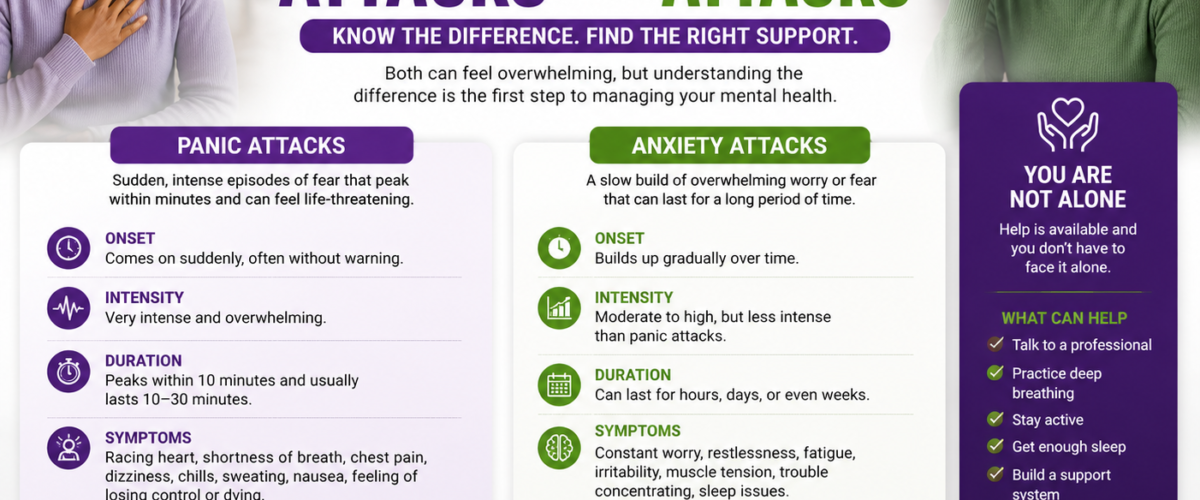
Panic Attacks vs Anxiety Attacks: What’s the Difference?

Many people use the terms panic attacks and anxiety attacks as if they mean the same thing.
It’s easy to see why.
Both can feel overwhelming. Both can create intense emotional and physical symptoms. Both can leave someone feeling frightened, exhausted, and unsure about what just happened.
Yet there are important differences between the two.
Understanding those differences can help people recognize what they are experiencing, seek appropriate support, and avoid unnecessary fear.
One of the most common concerns mental health professionals hear is, “I thought I was having a heart attack.”
Another is, “I don’t know if this is anxiety or something more serious.”
These concerns are understandable. Panic attacks and anxiety attacks can feel frightening, especially when symptoms appear suddenly or become difficult to control.
This guide explains how panic attacks and anxiety attacks differ, what causes them, when professional help may be beneficial, and what steps can help someone move forward with confidence.
Why the Difference Matters
At first glance, distinguishing between panic attacks and anxiety attacks may seem unimportant.
After all, both involve anxiety.
However, understanding the distinction helps people make sense of their symptoms.
It also helps healthcare providers determine whether someone may be experiencing panic disorder, generalized anxiety disorder, social anxiety, trauma related symptoms, or another mental health condition.
Accurate understanding leads to more effective treatment.
Misunderstanding symptoms often leads people to delay seeking help or focus on the wrong solutions.
What Is an Anxiety Attack?
Interestingly, the term anxiety attack is widely used but does not have a formal clinical definition in the same way panic attacks do.
Most people use the phrase anxiety attack to describe a period of intense anxiety that gradually builds in response to stress, worry, or fear.
Anxiety attacks often develop around specific concerns.
A person worried about finances may feel anxiety building throughout the day.
Someone anticipating a major presentation may notice increasing tension, nervousness, and physical discomfort.
Anxiety usually has a recognizable trigger.
The symptoms often grow gradually rather than appearing instantly.
Common Anxiety Attack Symptoms
Anxiety attacks can affect both the mind and body.
People frequently describe excessive worry, restlessness, muscle tension, difficulty concentrating, irritability, rapid heartbeat, sweating, nausea, and trouble sleeping.
The intensity varies.
Some people remain functional while feeling anxious.
Others find symptoms significantly interfere with daily life.
What Is a Panic Attack?
Panic attacks are different.
A panic attack is a sudden surge of intense fear or discomfort that reaches its peak within minutes.
The experience can feel abrupt and overwhelming.
Many people report feeling completely fine one moment and terrified the next.
Unlike anxiety attacks, panic attacks can occur without an obvious trigger.
Someone may be relaxing at home, driving to work, or shopping at a grocery store when symptoms suddenly begin.
This unpredictability is one reason panic attacks often feel especially frightening.
Common Panic Attack Symptoms
Panic attacks frequently involve intense physical sensations.
People often experience chest pain, shortness of breath, dizziness, trembling, sweating, heart palpitations, numbness, tingling sensations, nausea, and feelings of losing control.
Some describe feeling detached from reality or disconnected from themselves.
Others fear they are dying.
These experiences can feel so convincing that many people seek emergency medical care during their first panic attack.
The Key Differences Between Panic Attacks and Anxiety Attacks
The distinction becomes clearer when looking at how symptoms develop.
Anxiety attacks generally build over time.
Panic attacks usually appear suddenly.
Anxiety often revolves around a specific concern or stressor.
Panic attacks may occur without warning.
Anxiety symptoms can persist for hours, days, or even weeks.
Panic attacks tend to peak rapidly and often resolve within twenty to thirty minutes, although lingering anxiety may remain afterward.
One way patients often describe the difference is this:
Anxiety feels like a storm slowly approaching.
A panic attack feels like a lightning strike.
Why Panic Attacks Feel So Physical
One aspect many articles overlook is why panic attacks create such intense physical symptoms.
The body’s fight or flight response plays a major role.
When the brain perceives danger, it releases stress hormones that prepare the body for action.
Heart rate increases.
Breathing changes.
Muscles tighten.
Blood flow shifts toward large muscle groups.
During a true emergency, these responses can be protective.
During a panic attack, they occur even when no immediate danger exists.
This creates symptoms that feel alarming but are often not physically harmful.
Understanding this process helps reduce fear surrounding the experience.
Common Triggers for Anxiety and Panic
Triggers vary from person to person.
For anxiety attacks, common triggers include work stress, financial pressure, relationship problems, health concerns, academic demands, and ongoing uncertainty.
Panic attacks may develop during periods of high stress, but they can also occur unexpectedly.
Certain factors increase vulnerability.
Sleep deprivation, excessive caffeine intake, chronic stress, trauma history, substance use, and underlying anxiety disorders can all contribute.
Recognizing patterns can be an important part of treatment.
Mistakes People Commonly Make
One of the biggest mistakes is assuming symptoms will simply disappear on their own.
While occasional anxiety is normal, recurring panic attacks or persistent anxiety deserve attention.
Another common mistake is avoiding situations associated with symptoms.
Someone who experiences a panic attack while driving may stop driving altogether.
Another person may avoid crowded places after having symptoms in public.
While avoidance can provide short term relief, it often strengthens fear over time.
People also frequently self diagnose based on information from social media or online forums.
Accurate evaluation requires a broader understanding of symptoms, medical history, and individual circumstances.
When Should You Seek Professional Help?
Many people wonder where the line exists between normal stress and a condition that requires treatment.
A useful guideline is to consider impact.
If symptoms interfere with work, relationships, sleep, daily activities, or overall quality of life, professional support may be beneficial.
Frequent panic attacks deserve evaluation.
Persistent anxiety that feels difficult to manage also warrants attention.
Seeking help early often prevents symptoms from becoming more disruptive.
How Mental Health Professionals Evaluate Symptoms
A comprehensive mental health evaluation looks beyond symptoms alone.
Providers explore medical history, emotional wellbeing, stressors, family history, sleep patterns, physical health, and lifestyle factors.
This process helps identify whether symptoms are related to panic disorder, generalized anxiety disorder, social anxiety disorder, post traumatic stress disorder, depression, or another condition.
The goal is not simply assigning a label.
The goal is understanding what is happening and identifying effective solutions.
Treatment Options That Can Help
Treatment depends on the individual’s needs.
For many people, therapy plays an important role.
Cognitive behavioral therapy is frequently used because it helps individuals recognize thought patterns and behaviors that contribute to anxiety and panic.
Some people benefit from medication management when symptoms become severe or persistent.
Lifestyle changes can also have meaningful impact.
Improved sleep habits, regular physical activity, stress reduction strategies, and limiting excessive caffeine intake often support recovery.
Treatment works best when tailored to the person rather than applying the same approach to everyone.
Long Term Outlook
Many people worry that panic attacks or severe anxiety will control their lives forever.
Fortunately, that is often not the case.
With proper treatment and support, many individuals experience significant improvement.
Symptoms become more manageable.
Confidence returns.
Daily activities feel less restricted.
Progress rarely happens overnight.
It often occurs gradually through consistent care, education, and healthy coping strategies.
What Family Members and Loved Ones Should Know
Watching someone experience a panic attack can be frightening.
Friends and family often feel unsure how to respond.
The most helpful approach is usually remaining calm, offering reassurance, and avoiding judgment.
Telling someone to “just relax” rarely helps.
Listening, supporting, and encouraging professional care when appropriate is often far more effective.
Mental health recovery is easier when people feel supported rather than criticized.
Final Thoughts
Panic attacks and anxiety attacks share similarities, but they are not identical experiences.
Anxiety attacks typically build gradually around stress or worry. Panic attacks appear suddenly and often involve intense physical symptoms that can feel alarming.
Understanding these differences helps people make sense of what they are experiencing and seek appropriate support when needed.
Most importantly, recurring anxiety or panic symptoms are not something you have to navigate alone.
Effective treatments exist. Professional guidance can provide clarity, reassurance, and practical tools that help people regain control of their lives.
If symptoms are interfering with your wellbeing, reaching out for support may be one of the most important steps you take.